| BizBridges |  |
Home / BizBridges /
|
|
|
 |
| Management/ Strategy |
| Management Lessons from the recent IPL T20 Cricket Tournament |
| Author : | thedesk |
| Institute : | |
| Posting Date : | 03/06/08 |


|
|
|
|
|
|
|
|
6bridges has strived to connect significant events around us to the practice of management in our professional lives. The Indian Premier League T20 - did we have some interesting things about management to learn from it? Read on to find out!
|
|
|
The Indian Premier League (IPL) 2008 has been one of the fascinating events of the year, which has grabbed eyeballs globally. T20 in the IPL format has built up the excitement that a waning world cup cricket failed to achieve last year. One of the remarkable things about this tournament has been its timing. A tournament so immaculately timed that it has followed India’s win in the T20 world cup and fed on the frenzy of interest generated after the unexpected T20 world cup win.
The IPL has witnessed a few absorbing aspects, like the franchises building teams like they would in a corporate mega project, replete with CEO, Director of cricket operations, coach, captain and the support staff. When Sohail Tanveer hit the winning runs for Team Jaipur in the final, we at thedesk squabbled, as usual, about the pros and cons of the tournament. However, we had a consensus about the management lessons learnt from the IPL that would be of interest in a corporate world.
Persevere with your business idea even if results take a while
Foresight in getting the right people
Systems and process are at the heart of operations
Identify clear roles for team members
Don’t let decision making become too predictable and thus lose dynamism
Don’t frown when the chips are down: Have an alternative strategy
Encourage and trust ordinary men to do extraordinary deeds
Build smart leaders that will deliver
Team Management Performance Graph Table
*******
Persevere with your business idea even if results take a while
To begin with, one of the big stories is the development of this innovative T20 concept. The concept of wealth generation through innovation is a business theory that is lauded but never really practiced for the want various reasons - some professional, mostly cultural. In a country starved of original ideas, where dynamism is frowned upon as inconceivable and innovation generally seen as a whim of an errant professional, the courage to pursue this idea to fruition has been commendable. Lalit Modi’s idea, conceived some years ago, has been finally implemented and marketed brilliantly. Of course, as it happens in India, the faction that started ICL actually had a hand in starting IPL too, by default though!
Many a times we see entrepreneurs trying out new ideas, but since ideas need time to bring results, they are often discarded or left in the cold storage once the owners of the idea loses faith in it. The fruit of perseverance may take time but if the niche target group is identified and the implementation well thought out, effective penetration of the market is a real possibility. The business idea and the plan are amongst the most important components of a business, and this is particularly true of a young firm that has set out to establish itself in the market.
*******
Foresight in getting the right people
When the IPL started, there was a rush to get the top stars in respective teams. The pundits predicted that some teams like the Deccan Chargers would run over others easily. The Kolkata Knightriders were also predicted to be a tough challenge for most teams. The pundits had egg on their faces within a fortnight of the IPL. While the Chargers never had their batteries charged, the Riders bid us good night faster than we thought. It wasn’t the teams with the marquee line-ups that were winning. It was instead the team of Shane Warne’s Rajasthan Royals, with local youngsters in it, who showed why you don’t really need big lineage to be called royal. Some teams like Knight Riders and Chennai complained that they had lost players like Ponting, McCullum, Hussey and Hayden to international tours, but the question that remained was - weren’t they aware when they chose their line ups that players were needed to be available throughout the league if they were to utilized optimally. The Bangalore team chose players like Jaffer and Kallis, proven test players who can mistake T20 for a fighter aircraft rather than a cricket format while Kolkata chose Akash Chopra who looks like a lamb stuck amongst speeding cars on Marine Drive and Shoaib Akhtar, a speeding, aging Porsche with no bonnet beyond the windshield! Compare this to the Kings XI Punjab from Mohali who had a balanced side of good pace bowlers, a quality spinner in Piyush Chawla, masterstroke in Shaun Marsh and a reliable batting order that combined the experience of Sangakara, Jayawardene and Yuvraj.
The difficulty was of picking players and having them play throughout. Since some players were going to be away, they had to select good replacements. The trick was in answering this question: where do you find equally good replacements? The answer was simple - Australia and to some extent South Africa. That’s because domestic standards are so high there that if you answer to their players knocking on international doors, you’ll open the door to some guys that are likely to be better than a few of the international players in the subcontinent.
In an organization, it is critical to plan on getting the right combination. One needs to understand the skills required to achieve the goals in the team. What do we need to do? Do we have the right people to do it? Is it the right balance? If they are the right people, will they stay long enough to achieve the targets? If not, where do you find the right people? In doing so, one needs to sometimes think outside the box, if need be. Most importantly, one needs to align goals with skills required and then chalk out a plan to fill the positions. It must also be remembered that merely picking up guys on reputation may not be the best idea. The ability to gauge the promise, fit, capacity and stability in a potential team member is so important that it actually helps you picture the workflow better and more definitely.
*******
Systems and process are at the heart of operations
The Knight Riders began with a bang, but what happened after a couple of their stars left? They sped away, stuttered, picked up, spluttered and then fizzled out like a toy on low battery. After Hayden and Hussey left, Chennai were ambushed frequently. However, while Sourav Ganguly did not set up a system that could stand changes midway, Mahendra Singh Dhoni took sometime but used the resources well to have a process in place. The use of 8 opening combinations in the Kolkata team, the overuse of the under-performing Ajit Agarkar and Akash Chopra, the waste of Shoaib Akhtar, the underused Umar Gul and the overused Ishant Sharma, as against the Chennai team’s use of Raina up the order, Gony and Morkel in bowling and the faith in Fleming proved that Dhoni had a definite plan in mind while Ganguly didn’t. Also, Dravid and his Bangalore Royal Challengers never used Misbah ul Haq well, wasted Praveen Kumar and lacked fizz in their preparation. In contrast, Jaipur used pinch hitters at the top of the order and kept wickets in hand towards the end. Warne also sometimes rotated bowlers in such a manner that they had a few experienced guys to bowl at the death.
Many times, leaders spend more time being mere checklist managers rather than thinking ahead and planning well. This is a tendency that harms the growth of a team, going forward. Setting up systems and processes instead of relying on a few people can hedge against sudden downturns and unexpected attrition. Even when the chips are down, a good process driven culture will always be able to sustain a level of performance that is consistent with expectations while a work environment without structured processes will always remain at the mercy of ad hoc policies. In most cases, a crisis can lead a company lacking processes, hurtling into a harsher crisis.
*******
Identify clear roles for team members
If you noticed there were teams that looked sparklingly confident while there were those that looked to have gotten up from their afternoon siesta and leapt onto the field without as much as a mouthwash. This is because some teams had a clear set of roles for its members and thus produced a higher level of performances from their players, given the clarity, while others ended the tournament trying to still figure out if its T20 or tea - twenty. There are glaring examples to support this. While Team Hyderabad’s Shahid Afridi looked like he was in a terrible hurry to catch the first flight out each time he played, his Pakistani teammate Kamran Akmal, a similar style of batsman from Team Jaipur, knew exactly what he was required to do each time he went to bat. He would come in after 3-4 wickets, hammer the daylights out of the poor bowlers and help his team get closer to the target score.
Take a look at Harbhajan Singh. While he took on the frankly unproductive role of slapping rival players, Swapnil Asnodkar of Team Jaipur bathandled rival bowlers better. The latter had a clear role given by Warne. So was someone like Munaf Patel. Munaf is the only cricketer I know who looks so harassed while fielding - like an endangered species being about to be hit by a pellet when the ball travels to him - that the thought of bowling must be leaving him mortally petrified. At the IPL, one couldn’t believe it was the same Munaf running up and delivering consistently. Warne made a mention how he used Munaf to throw in certain inputs while planning, and also drew on his strengths to bowl one line and choke the runs.
In an organization, choose the key positions in your team after having understood the business goals. Before recruiting the best team one must identify what is essential for the overall performance of the team and then work towards filling the positions that help the accomplishment of goals. It is important to also understand the strengths and weaknesses of the members in a corporate team. If Warne thought Munaf’s best chance was to choke runs because of his bounce, he pushed him to achieve that. If you have chosen someone in your team, there has to be optimal use of him. If a member or some members are not being used optimally, it means there is room for improvement. To get the best out of your team, it is necessary that the roles are clearly defined and the expectations spelt out. Clarity in decision-making is appreciated and in return, rewarded with an equally deserving response.
*******
Don’t let decision making become too predictable and thus lose dynamism
If the Knight Riders found to their dismay that the pint sized Swapnil Asnodkar could launch balls into the stands, it was because Warne had a role for him - shock the opposition before it settles down. When Chennai was chasing a mere 130, Dravid brought on Kumble, a leg spinner, to open the bowling attack instead of a conventional pacer. Chennai were a tad confused on how to counter this change. When Brendon McCullum smashed Bangalore in the lung opener, the opposition was so shell shocked that the challengers looked like surrenderees. In the semifinals, when Dhoni made Murali open the bowling instead of a pace bowler, it left Yuvraj Singh’s team with two left feet to do the bhangra.
It is crucial to have that vital card up your sleeve when you are taking decisions. Becoming predictable in every count may make you less effective. Mumbai Indians kept having the same batting and bowling order and that made them too predictable. Having an element of unpredictability as a decision maker is sometimes effective against complacency, and it also allows for team members to think through and contribute if he/she feels that there is an additional contribution expected and a status quo is not acceptable all the time.
*******
Don’t frown when the chips are down: Have an alternative strategy
The biggest hurdle for the Royal Challengers was when their fighting spirit was being royally challenged. Vijay Mallya showed us how the king of good times couldn’t ride out the bad times well enough. When Jayasuriya went berserk against some teams, they didn’t quite know what to do. When Ganguly went into overdrive against Mohali, the kings didn’t look too majestic handling that either.
Mumbai Indians fought better after being 4 down from 4 matches but even they did not have an alternative strategy. Sharukh Khan, on the other hand was impeccable in his public conduct with the team even when the knights were having a rough ride. From the others, it was Shane Warne’s army from the pink city that looked more positive than most. Every time they looked down the barrel of a gun, there was a Ravindra Jadeja or a Niraj Patel (against Mumbai) to smoke out the opposition. When Dhoni was asked if he was ever nervous and whether he ever felt pressure, he replied that he would be lying if he said there was no pressure, but added that if a bowler were to see his captain worried, his confidence would get affected badly. That’s why it worked for him to hide his pressure as a leader on the field. That was a great management lesson from a cool, proven practitioner of leadership.
There will be times when the going is tough and there is a lean patch. It is important to be consistent and not let performance wilt under pressure. In a corporate environment, there will be times when revenues are down, clients hard to please, and output (results) not exactly commensurate with the input (hard work). Leaders will face times when the pressure will be upto the chin, but then the best are those who survive by not wilting under pressure but by thinking ahead about the possible alternative courses.
*******
Encourage and trust ordinary men to do extraordinary deeds
Remember the T20 world cup final over. When Joginder Sharma and Misbah ul Haq were anointed hero and villain respectively. Remember Praveen Kumar in Australia. Now, think of Manpreet Gony in IPL. Gony seems more likely to go farther than the other two, though all three have shone in similar circumstances - under pressure. However, Gony has done it consistently and therefore there is a sense of responsibility which shines through in his case.
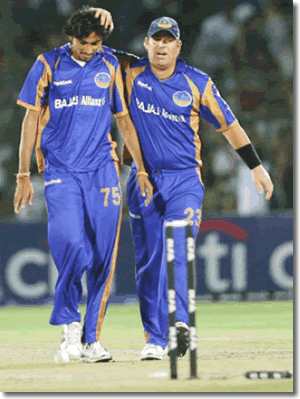
How do you get ordinary men to do extraordinary deeds? Did you get to see Warne praise Jadeja, Salunkhe, Patel, Yusuf Pathan and others after every match? That’s the answer - getting people to believe in themselves. A good leader is some one who does that all the time.
When you praise people who work hard and acknowledge their good work, it builds a sense of responsibility. It also creates a culture of accountability. Building individuals who are committed is done through a principle of mutual respect and trust. Acknowledging efforts and bonding well is like building the blocks for enabling long-term growth in any organization.
*******
Build smart leaders that will deliver
One of the biggest positives from the IPL has been the impact of leaders who think on their feet and keep their heads cool. Rahul Dravid tried hard but was inflexible. Saurav Ganguly tried to be attacking but didn’t have plan B. Mumbai never had a captain and hence didn’t have plan A. Yuvraj was good when the going wasn’t rough, but he couldn’t deliver despite the best arsenal at his disposal. Sehwag is a smart thinker but faltered at identifying his crisis manager at crucial times. Dhoni and Warne came out the smartest of the lot.
When Shane Warne came to Jaipur before the IPL, he didn’t know much about the Indian players that were a part of the team. He worked with them till 4am on a few days before the tournament. He came up with a vision for the team and worked individually with players. He had a role plan for players regarding their batting, bowling and fielding. One of the biggest things the IPL has achieved is build a caucus of promising players that will form the nucleus of Indian and world cricket for the future. In that respect, all the captains - Rahul, Saurav, MSD, Warney, Yuvraj, Gilly and Sachin contributed immensely.
Leadership is nothing if it doesn’t build a culture of excellence. Smart leaders in an organization will help build that essential core that will help an organization vault over the tipping point and make excellence its hallmark. In essence, exposing people to situations helps an organization understand potential of its people better and nurturing them through dynamic and experienced leadership helps them overachieve consistently.
As Walter Lippman wrote, “the final test of a leader is that he leaves behind in other men, the conviction and the will to carry on…The genius of a good leader is to leave behind him a situation which common sense, without the grace of genius, can deal with successfully.”
Team Management Performance Graph Table
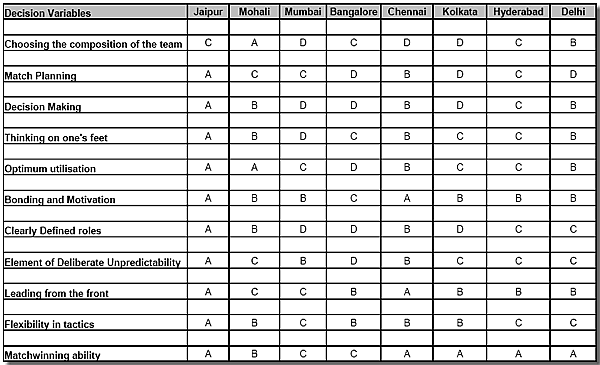
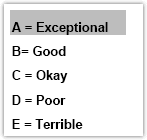
Note: This table above is an assessment made by thedesk and it does not represent any official release from the IPL.
Sources:
http://content-ind.cricinfo.com/ipl/content/current/story/353267.html
,, |
|
|
|
|
|
 | Messages/Opinions |
|
|
|  | 1) IPL is a threat to the game of cricket
Amar Shukla JBIMS'01 |17/06/08 | replies: 0| Post Reply | | |
Cricket is a gentleman s game and by commercialising it the true strength of strategies and plans for a game cannot be evaluated in such a short game format. It is also unfairly balanced in favour of the batsmen while the bowlers are only present to toss the ball up to be hit into the stands. T20 will also take away the uniqueness of test cricket as it is the only game where a tussle ensues over 5 days that tests ones patience character and stamina. T20 will produce more news through unruly incidents like slapping opponents sensational things like cheerleaders and exchange of mind-boggling sums of money. Does any of you think that the T20 is fair and free from match-fixing I have my doubts...especially since fortunes can change quickly in this shortened format. What do you think I feel its just a better alternative to Saas-Bahu Serials.
Send Personal Mail |
|  | 2) Vikas V
Vikas Vasisht NIT(Warangal)'95 |08/06/08 | replies: 0| Post Reply | | | |
| |
Click Here to login and post message
|
| Indian Alumni and Students from the following Indian and Global Institutes are invited to be members of 6bridges.com: |
| |
| India |
| Business & Accounting Institutes : FMS, ICAI, IIFT, IIM(A), IIM(B), IIM(C), IIM(I), IIM(K), IIM(L), IRMA(Anand), ISB, JBIMS, MDI(Gurgaon), NITIE, NMIMS, SJMSOM(IIT Bombay), SPJIMR, TISS, XIMB, XLRI |
| Technology Institutes : BIT(Mesra), BITS(Pilani), COE-Guindy(Anna Univ.), DCE, IISc, IIT(B), IIT(M), IIT(D), IIT(G), IIT(K), IIT(Kgp),IIT(Roorkee), ISI(Kolkatta), ISM (Dhanbad), IT-BHU, Jadavpur Univ., National Institutes of Technology(RECs), PSG(Coimbatore), RVCE(Bangalore), VJTI |
| |
| Global |
| Business, Technology & Accounting Universities/Institutes : AGSM(Sydney), AIM(Manila), Caltech, Carnegie Mellon, Columbia, Cornell, Dartmouth, Duke, Georgia Tech, Harvard, ICAEW(UK), IMD(Switzerland), INSEAD, Judge(Cambridge), London Business School, Manchester, Melbourne Business School, Michigan, MIT, Northwestern, NYU, Princeton, Purdue, Queen's(Canada), Said(Oxford), Stanford, U.Chicago, U.Penn, UC Berkeley, UCLA, Univ. of Illinois-Urbana, Univ. of Southern California, Univ. of Virginia, Warwick, Yale |
|
|