| BesidesWork |  |
Home / BesidesWork /
|
|
|
 |
| Fascinating India |
| Bolting Bullocks, Cantering Camels, Swishing Snake Boats: Traditional Racing in India |
| Author : | thedesk |
| Institute : | |
| Posting Date : | 16/06/10 |


|
|
|
| Total 15 vote(s). |  | |
|
|
|
|
|
The versatile traditions of racing chariots, camels, boats and bullocks in India.
|
|
|
In the dusty tracks of Kila Raipur, a village near Ludhiana in Punjab, one hundred bullock carts line up to race against each other. Each cart is meant to record a separate time trial over a specified distance. There are over a hundred participants but like all sports, there can only be one winner. There are other events and races that are held at the Killa Raipur festival which include a dog race, a camel race and a tractor race. The sports festival has the aura of an Olympics in these villages in Punjab, and the games indeed live up to its name.
This time, Bela Singh of Langrah village is declared the winner of the cart race.
He and his bullocks have outpaced their opponents, dust trailing in the wake of thumping hoofs and rampaging wheels, to become the fastest bullock cart of this edition of the Killa Raipur olympics. No mean feat this, since speed racing is universally an exhilarating sight – and enthusiasm for a traditional bullock cart race confirms how racing remains a simple yet sustained piece of attraction.
Speed, endurance and racing have always held human interest and curiosity.

Races in competitions involving pace and swiftness have upped testosterone levels ever since man began to learn to run during civilization’s infancy.
Mythologies and ancient histories across India, Egypt, Rome and Greece have basked in thrilling, spectacular races of lunging, heaving and charging humans,
camels, elephants and horses bolting past less speedier rivals. Racing - that cheapest, harmless, most natural and primary of sports on earth has been,
over time, slowly tamed with cloaks of custom, tradition, rules and gamesmanship.
Different types of races were developed and man found versatile ways to cover the distance from the start to the finish line.
Charioteers took the horses out to gallop while rowers and sailors took to the dhows, and racing one against the other in different conditions
over a specified distance sent pulses throbbing. The Indian, Greek and Roman mythologies and histories are all littered with tales of chariot races,
stupendous finishes, bets, winners and losers. The idea of a marathon, that race where endurance expands the idea of pace, was also born from the
fable of a Greek soldier Pheidippides running all the way from the battle of Marathon to Athens to convey the news of a famous victory.
Chariot Racing
Chariot racing was dangerous to both driver and horse as they frequently suffered serious injury and even death,
but generated strong spectator enthusiasm. Numerous varieties of carts and chariots in prehistoric cave shelter paintings
have been found in Central India, and there have been races organized by tribes against each other over the ages.
Age has been less of a deterrent in village and tribal sports events.
In the Kila Raipur festival, veterans vie with youngsters to prove their stamina and physical strengths.
From Chariot to Cattle Races
As the year comes to an end, time arrives for the Kalapootu cattle race at Pullaloor in Palakkad.
This race is organized when farmers are free from working in their fields and is an extremely popular one.
The enticing show of 120 pairs of cattle cantering through paddy fields surely kicks up quite a sight.
Though cattle races have been banned at places, there are the odd occasions during March-April when you have bullock-cart races along the Nagaon beach
in Maharashtra. Villagers turn up at the beach with their sturdy bullocks for a sprint down the white sands of this pebble-free, hard beach.
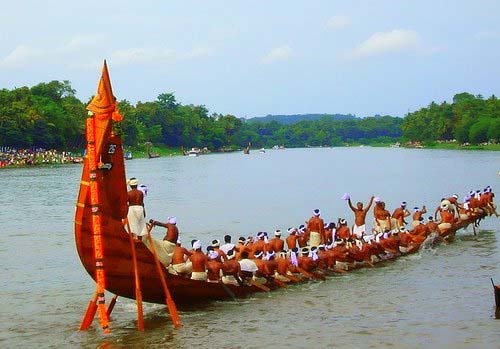
The Snake Boat Race
Vallam Kalli, meaning boat race in Malayalam, is the traditional race involving paddled canoes in Kerala. It is held during the season of
the harvest festival Onam. The race of Chundan Vallam (snake boat) is the major event and is a major tourist attraction.
The boat race in Aranmula is about retracing those times when offerings were carried on snake boats to the Aranmula Parthasarthy Temple.
It takes place at Aranmula, near a Hindu temple dedicated to Lord Krishna and Arjuna. The snake boats move in pairs to the rhythm of
full-throated singing and shouting watched by a rapturous crowd.
The race is a grueling one spanning 40 kilometres. Traditionally, thirty boats, each 100 to 120 feet long, with around 100 rowers in them would row downhill. Each village has its own snake boat and they take great pride in maintaining and taking care of it before they bring it to the races. Every year the villagers get together and race these boats along the lakes and rivers.

The History Behind Snake Boat Races
Over 400 years ago, the kings of Allepey and those from the adjoining areas would fight using boats along the canals.
One day, a king who had engaged in a fight, suffered heavy losses and began wondering what could be the solution. That’s when he called architects
to sit down with him and planned on a stronger, better-designed vessel. Thus, the snake boat, with its warrior design was born.
An opposing king sent a spy to learn the secret of how to make theses boats but was unsuccessful as the subtleties of the design are very hard
to pick up. Gradually however, the art was learnt and today, these boat races are extremely popular and there is loud and frenzied cheer
and applause reserved for the competitors.
When and where is the Snake Boat Race Held?
Today, four main snake boat races and 15 minor ones are held in and around Allepey. Snake boat races are mostly held on the
dates depending on the phase of the moon. The oldest and most popular race, the Champakkulam Moolam, is held along
the river at Champakkulam (Changanassery), around 25 kilometers from Alleppey.
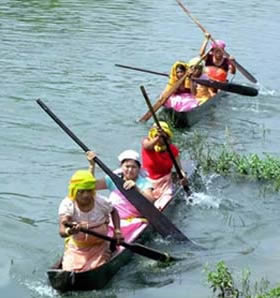
Boat Racing in Manipur
Hiyang Tanaba is a famous boat race that takes place in Manipur during the popular festival Lai Haroba. There is a belief among the Meiteis, a tribal community found in Imphal valley, that the worship of Hiyang Hiren would counteract the evil spirits. It is believed that boat construction had been invented by the famous ‘deluge’ that had occurred in this part of the world after the Mahabharata period after which boat races became a popular contest.
On the final day of the festival the race takes the form of a game called hikaba where only men are allowed to take part.
The boat is called hee and the oars are called nou, and participants dress up in colorful traditional outfits.
The size and shape of the boat are not specific but need to be big enough for 20 people to occupy each boat in the race.
This sport is usually held in November at Thangapat. Hiyang Tanaba is also conducted at the time of natural disaster.
Camel races of Rajasthan
Every year in November thousands of Rajasthani tribal people come together in the picturesque town of Pushkar - a major site for Hindu pilgrims. They come here to trade camels and other cattle, and go to bathe at the Pushkar lake which is held to be sacred by Hindus. They come here and entertain themselves with the camel races and local circuses, and to browse the local markets for camel saddles, textiles, glass bangles and silver jewelry. People fill up the winding streets in all their finery during this time - men in crisp white dhotis and rich, multihued turbans, and women with their colourful, scarlet veils, wearing dazzling ivory jewelry and colourful attire for the occasion.
The race is very interesting and offers opportunities for laying bets. The race takes place amidst the din and bustle caused by folk dancing and music.
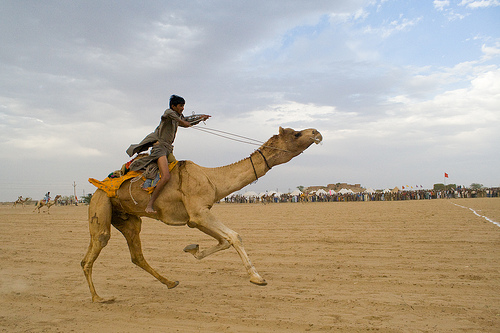
The atmosphere is charged with merriment, excitement and raw energy. As the camels start racing, the rising dunes offer a spectacular sight. Some camels even stop short and drop out and some run off the track. The riders are anxious to ride their camels across the finishing line amidst the cheering and applauding from the spectators.
Camel racing in Pushkar is symbolic of the tradition of this place. It is very popular with tourists too. The Pushkar fair is a mélange of brilliant colours and the manner in which the camels are dressed up with colorful saddles, beads and cowries only reflects the music, colour and a sense of celebration in this part of Rajasthan that accompanies this festival.
Whether it is camels, cattle, bullock, carts and humans, the romance of racing and speed has a simple correlation with the basic human urge to be faster.
Speed and thrills have remained the essence of various simple and straightforward versions of the sport of racing.
Which is why racing has had a universal appeal across traditional societies in India – whether it be land or water.
The idea of pace and speed makes for a breathtaking sight, one that makes people stop, look and gape in collective awe
till someone from the exploding bunch breasts the finishing line – whether it is a Usain Bolt or the bullocks of Killa Raipur.
Sources:
http://goindia.about.com/od/whattosee/p/snake-boat-race.htm
http://www.keralahome.in/en/interesting.html
http://en.wikipedia.org/wiki/Aranmula_Boat_Race
http://www.india-rajasthan-tours.com/rajasthan-fairs-and-festivals/pushkar-fair.html
http://forum.desicomments.com/showthread.php?t=28278
http://www.india-rajasthan-tours.com/rajasthan-fairs-and-festivals/pushkar-fair.html
http://www.manipur.nic.in/indgames.htm
, |
| Total 15 vote(s). | | |
|
|
|
|
|
 | Messages/Opinions |
|
|
| | No messages yet! Be the first one to post a message here. |
|
Click Here to login and post message
|
| Indian Alumni and Students from the following Indian and Global Institutes are invited to be members of 6bridges.com: |
| |
| India |
| Business & Accounting Institutes : FMS, ICAI, IIFT, IIM(A), IIM(B), IIM(C), IIM(I), IIM(K), IIM(L), IRMA(Anand), ISB, JBIMS, MDI(Gurgaon), NITIE, NMIMS, SJMSOM(IIT Bombay), SPJIMR, TISS, XIMB, XLRI |
| Technology Institutes : BIT(Mesra), BITS(Pilani), COE-Guindy(Anna Univ.), DCE, IISc, IIT(B), IIT(M), IIT(D), IIT(G), IIT(K), IIT(Kgp),IIT(Roorkee), ISI(Kolkatta), ISM (Dhanbad), IT-BHU, Jadavpur Univ., National Institutes of Technology(RECs), PSG(Coimbatore), RVCE(Bangalore), VJTI |
| |
| Global |
| Business, Technology & Accounting Universities/Institutes : AGSM(Sydney), AIM(Manila), Caltech, Carnegie Mellon, Columbia, Cornell, Dartmouth, Duke, Georgia Tech, Harvard, ICAEW(UK), IMD(Switzerland), INSEAD, Judge(Cambridge), London Business School, Manchester, Melbourne Business School, Michigan, MIT, Northwestern, NYU, Princeton, Purdue, Queen's(Canada), Said(Oxford), Stanford, U.Chicago, U.Penn, UC Berkeley, UCLA, Univ. of Illinois-Urbana, Univ. of Southern California, Univ. of Virginia, Warwick, Yale |
|
|